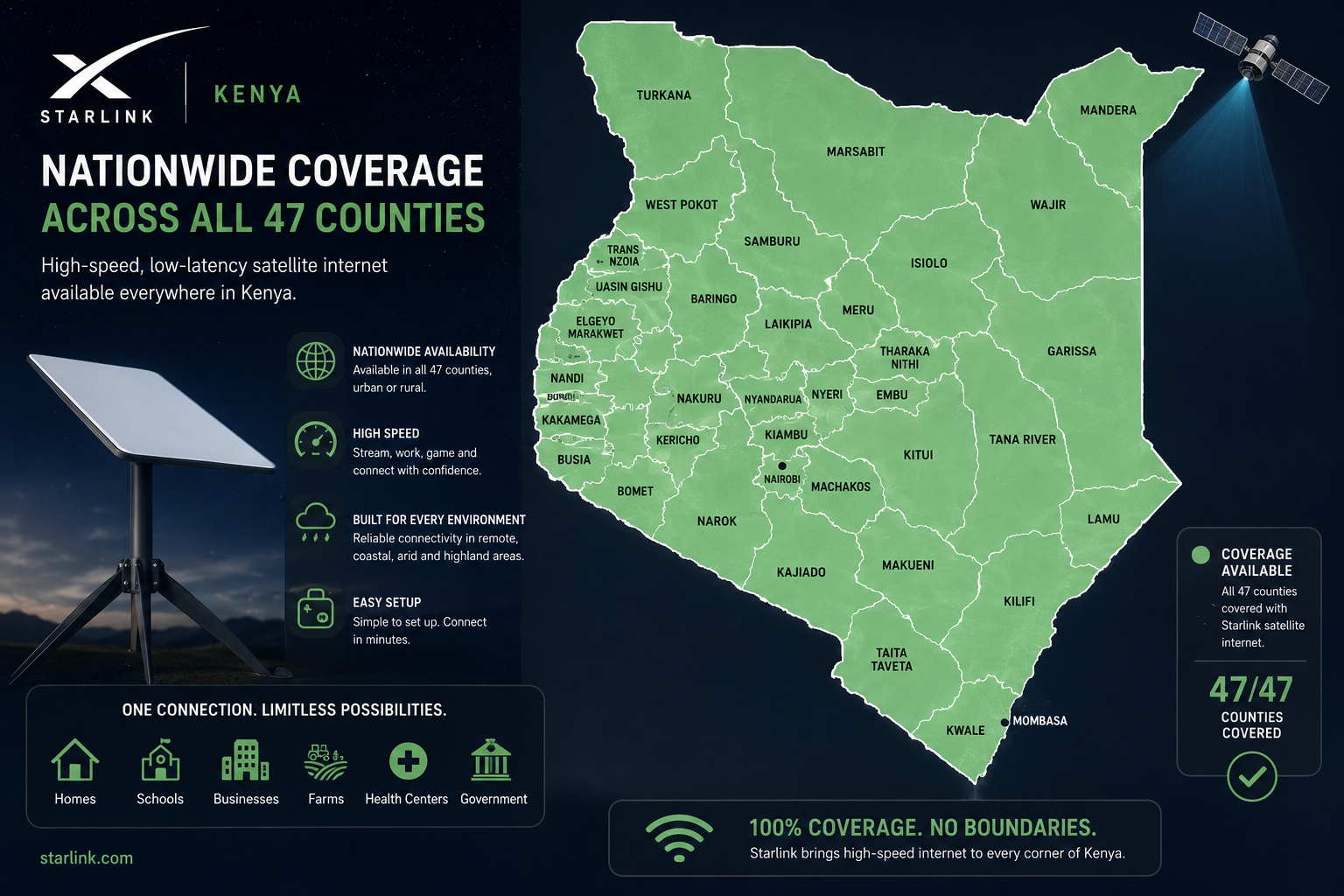
Kenya's internet landscape changed permanently when SpaceX's Starlink satellite network went live in the country in July 2023. Today, regardless of whether you live in a Nairobi apartment, manage a safari lodge in Laikipia, run a school in West Pokot, or captain a fishing vessel off the Kenyan coast, Starlink Kenya packages offer a plan designed for your situation. With 100 percent nationwide coverage now confirmed, the question is no longer whether Starlink works in your area — it is which Starlink Kenya package is right for your needs and budget.
This comprehensive guide covers every Starlink Kenya package available in 2026, including hardware costs, monthly fees in Kenyan shillings, data allocations, speed benchmarks, ideal use cases, and a step-by-step guide to getting connected. Whether you are comparing Starlink to Safaricom fibre or trying to decide between the Residential and Roam plans, this article gives you the complete picture.
You can also explore authorised resellers and installation specialists such as Orbitlink Solutions, Starlink Nairobi Installers, and Satellite Internet Installers Kenya for professional setup support across the country.
1. What Is Starlink and Why Does It Matter for Kenya?
Starlink is SpaceX's Low Earth Orbit (LEO) satellite internet service. Unlike traditional geostationary satellites that sit 35,000 kilometres above Earth, Starlink's constellation of over 9,400 satellites orbits at approximately 550 kilometres altitude. This proximity is what gives Starlink its competitive edge: low latency, high speeds, and reliable performance — even in areas where fibre cables and cell towers simply do not exist.
For Kenya, a country where over 60 percent of the population still lives outside reliable broadband coverage, Starlink's significance cannot be overstated. Rural farmers in Turkana, tea estate workers in Kericho, and remote health clinics in Isiolo now have access to the same internet quality as downtown Nairobi offices. As of February 2026, infrastructure upgrades have reduced Starlink's latency in Kenya by 87 percent, with most users reporting typical speeds of 150 to 220 Mbps during off-peak hours.
The Kenyan government licensed Starlink through the Communications Authority of Kenya (CA), making it a fully compliant, regulated internet service provider in the country. Payments can be made via M-Pesa, Visa, or Mastercard, significantly lowering the barrier to entry.
For more background on Starlink availability across Kenya, visit Starlite Internet Kenya and SpaceLink Kenya.
2. Starlink Kenya Hardware: What Equipment Do You Need?
Before choosing a monthly service plan, you need the right Starlink hardware kit. Every kit includes a self-aligning satellite dish (colloquially called "Dishy"), a Wi-Fi router, mounting hardware, and power cables. Setup takes under 30 minutes and no professional technician is required for basic installations.
2.1 Starlink Mini Kit — KES 27,000
The Starlink Mini is the most affordable and portable hardware option available in Kenya. Weighing just 1.1 kg and compact enough to fit in a backpack, the Mini is designed for individual users, remote workers, digital nomads, and SMEs needing a lightweight backup connection. It is solar-compatible, making it ideal for off-grid use in rural areas or game reserves.
The Mini kit was introduced to the Kenyan market in September 2024 and has become the fastest-growing segment of Starlink's Kenyan subscriber base. It works with all Starlink data plans — Residential, Residential Lite, and Roam — giving users maximum flexibility.
• Price: KES 27,000 (full retail); installment option available from KES 6,750 upfront
• Best for: Portable use, remote workers, SMEs, rural homes, backup internet
• Solar-compatible: Yes
• Self-install: Yes (under 30 minutes)
2.2 Starlink Standard Kit — KES 49,900 to KES 55,000
The Standard Kit is Starlink's primary hardware option for fixed residential and commercial installations. It delivers stronger signal reception, higher sustained speeds, and greater stability compared to the Mini. The Gen 3 V4 standard dish is the current model available in Kenya and is recommended for homes, offices, schools, and businesses where the dish will be permanently mounted.
• Price: KES 49,900 to KES 55,000 (varies by reseller and offer period)
• Best for: Homes, offices, schools, fixed business locations
• Speeds: 150–220 Mbps typical; up to 300 Mbps in optimal conditions
• Warranty: 1 year standard
2.3 Flat High-Performance Kit — KES 377,000+
The Flat High-Performance kit is designed for demanding commercial, maritime, and aviation applications. It features a ruggedised design, wider beam angle, and enhanced thermal management for operation in extreme conditions. This is the recommended hardware for vessels, aircraft, and large-scale enterprise deployments.
• Price: KES 377,000 and above
• Best for: Maritime vessels, aviation, oil and gas, enterprise networks
• IP rating: IP56 (wind/water resistant)
2.4 Installment Plan (Mini Kit)
Recognising that upfront hardware costs have been a barrier to adoption, Starlink introduced an instalment payment option in January 2026. Under this plan, customers pay KES 6,750 upfront for the Mini kit (compared to the full retail price of KES 27,000), plus a mandatory activation charge of KES 16,250, and shipping and handling fees of KES 3,010. The remaining hardware cost is then spread over six monthly instalments of KES 4,500 each. The standard KES 6,500 monthly subscription fee applies in addition to the instalment payments.
A rental option also remains available at KES 1,950 per month for the hardware, for those who prefer not to purchase outright.
3. All Starlink Kenya Packages: Complete Pricing & Plans for 2026
Below is a comprehensive summary of all available Starlink Kenya packages as of mid-2026. Prices are in Kenyan Shillings (KES) and exclude 16% VAT unless stated. Add 16% to get your actual billed amount.
|
Plan |
Hardware (KES) |
Monthly Fee (KES) |
Best For |
|
Residential (Unlimited) |
49,900–55,000 |
6,500 |
Homes, fixed offices, SMEs |
|
Residential Lite |
49,900–55,000 |
4,000 |
Light home users, budget-conscious |
|
Mini Kit + Residential |
27,000 |
6,500 |
Portable homes, remote workers |
|
Roam (Mobile Regional) |
27,000–43,000 |
14,000 |
Nomads, field teams, travel |
|
Business Priority 1 TB |
49,900–55,000 |
13,572 |
Offices, schools, enterprises |
|
Business Priority 2 TB |
49,900–55,000 |
27,144 |
High-traffic businesses |
|
Maritime / Aviation |
377,000+ |
Custom |
Vessels, aircraft, offshore ops |
Note: Hardware costs are one-time payments. Monthly fees are recurring service subscriptions. Prices are subject to change — confirm current pricing at starlink.com/ke or through an authorised reseller.
3.1 Starlink Residential (Unlimited) — KES 6,500/month
The Residential plan is Starlink's flagship package for Kenyan homes and fixed business locations. At KES 6,500 per month, it provides unlimited high-speed data with no hard data caps — you never run out of internet. While Starlink may deprioritise heavy users during peak congestion periods, this rarely affects everyday usage such as streaming, video calls, browsing, and remote work.
• Monthly cost: KES 6,500 (approximately KES 7,540 after 16% VAT)
• Data: Unlimited
• Speeds: 150–220 Mbps download, 10–20 Mbps upload (typical)
• Latency: 20–40 ms
• Hardware: Standard Kit (KES 49,900–55,000) or Mini (KES 27,000)
• Best for: Households, home offices, rural homes, apartments without fibre
• Portability: Fixed location; address changes allowed at no charge
For professional installation of the Residential plan across Nairobi and beyond, visit Starlink Kenya Installers.
3.2 Starlink Residential Lite — KES 4,000/month
Residential Lite offers the same coverage as the standard Residential plan but at a more affordable KES 4,000 per month. The trade-off is that Lite users are deprioritised on the network — meaning that during peak congestion periods, their traffic yields to higher-priority subscribers. For light to moderate users who primarily browse, use social media, make video calls, and stream in standard definition, Residential Lite is an excellent cost-effective option.
• Monthly cost: KES 4,000 (~KES 4,640 after VAT)
• Data: Unlimited (deprioritised during congestion)
• Speeds: Variable; typically 20–100 Mbps
• Best for: Light users, budget-conscious households, backup connections
3.3 Starlink 50 GB Plan — KES 1,300/month
For users with very light data needs or those looking for the lowest possible monthly commitment, the 50 GB plan at KES 1,300 per month is the most affordable Starlink package available in Kenya. Once the 50 GB allocation is exhausted, speeds are throttled significantly. This plan is best treated as an entry-level option or supplementary connection rather than a primary broadband service.
• Monthly cost: KES 1,300
• Data: 50 GB high-speed, then throttled
• Best for: Very light users, backup connections, trials
3.4 Starlink Roam (Mobile Regional) — KES 14,000/month
The Roam plan — also referred to as the Mobile Regional plan — is one of Starlink's most popular and fastest-growing packages in Kenya, having experienced 900 percent year-on-year growth in search interest. It removes the fixed-location restriction of the Residential plan, allowing users to use their Starlink dish anywhere within Kenya and across a growing number of countries in the region.
At KES 14,000 per month, the Roam plan is more expensive than Residential, but it offers unmatched flexibility for users who move frequently. Remote workers who divide their time between Nairobi and their home county, field engineers, safari operators, and Kenyan digital nomads travelling regionally are the primary beneficiaries.
• Monthly cost: KES 14,000 (~KES 16,240 after VAT)
• Data: Unlimited inland data
• In-motion use: Up to 16 kph (ideal for stationary or slow-moving vehicles)
• Pause option: KES 500/month standby fee (instead of full KES 14,000)
• Hardware: Starlink Mini (KES 27,000) or Standard Actuated Kit (KES 43,000)
• Best for: Nomads, remote workers, field teams, RVs, seasonal travellers
The combination of the Starlink Mini and the Roam plan is widely considered the most versatile portable internet solution in Kenya. Learn more at Starlink Kenya.
3.5 Starlink Business Priority Plans
For enterprises, schools, hospitals, and organisations that require guaranteed high-speed performance and dedicated support, Starlink offers Business Priority plans. These plans provide priority network access — meaning business subscribers are never deprioritised during peak hours — along with a public static IP address (useful for hosting servers or running enterprise applications) and 24/7 priority customer support.
Business Priority plans are tiered by monthly data allocation:
• Priority 40 GB: KES 8,000/month — suitable for small teams
• Priority 1 TB: KES 13,572/month — medium businesses and schools
• Priority 2 TB: KES 27,144/month — large offices and organisations
• Priority 6 TB: KES 81,432/month — data-intensive enterprises
All Business Priority plans include a public routable IPv4 address, making them the preferred choice for organisations running servers, VPNs, VoIP systems, or remote monitoring equipment.
3.6 Starlink Maritime & Aviation Packages
Starlink's maritime and aviation packages bring high-speed satellite broadband to fishing vessels, cargo ships, private yachts, charter aircraft, and commercial airlines operating in and out of Kenya. These packages use the Flat High-Performance hardware (KES 377,000+) and offer in-motion connectivity across ocean and air routes.
Maritime plans provide unlimited inland data and ocean connectivity, with network priority ensuring reliable performance even in remote offshore locations. Aviation plans offer similar capabilities at altitude. Pricing for maritime and aviation is customised based on usage volume and route patterns — operators should contact authorised dealers such as Satellite Internet Installers for bespoke quotations.
Get a maritime or aviation Starlink quote from Satellite Internet Installers Kenya.
4. Starlink Kenya vs. Other Internet Providers: How Does It Compare?
One of the most common questions Kenyan buyers ask is how Starlink compares to existing internet options. Below is a side-by-side comparison across the key decision factors.
|
Feature |
Starlink |
Safaricom Fibre |
4G Mobile |
|
Availability |
Nationwide (100%) |
Urban centres only |
Partial coverage |
|
Speeds (typical) |
150–220 Mbps |
20–100 Mbps |
5–50 Mbps |
|
Latency |
20–40 ms |
5–20 ms |
30–80 ms |
|
Monthly Cost |
KES 4,000–14,000 |
KES 2,500–5,000 |
KES 1,000–3,500 |
|
Setup Cost |
KES 27,000–55,000 |
Free–KES 5,000 |
Free (SIM card) |
|
Data Caps |
Unlimited / Priority |
Unlimited |
Capped or throttled |
|
Portability |
Yes (Roam plan) |
No |
Yes |
|
Off-grid Use |
Yes (solar-compat.) |
No |
Partial |
The comparison makes clear that Starlink's primary advantage is availability: it works everywhere in Kenya, including remote and rural areas entirely excluded by fibre networks. Its speeds comfortably outpace 4G mobile broadband and match or exceed mid-range fibre packages. The main trade-off is cost — Starlink's monthly fees are two to three times higher than entry-level Safaricom fibre. However, in areas where fibre is simply unavailable, Starlink is not competing with fibre — it is the only viable high-speed option.
For businesses and institutions in peri-urban or rural areas, the cost calculus frequently favours Starlink. The productivity gains from reliable 150+ Mbps internet, versus patchy 4G that may offer 5–15 Mbps on a good day, often justify the premium.
5. Which Starlink Kenya Package Is Right for You?
Choosing the right Starlink Kenya package comes down to three primary questions: Where do you use the internet? How much data do you need? And what is your budget? Below are the recommended packages for each user type.
5.1 Home Users in Rural or Peri-Urban Kenya
If you live outside Nairobi, Mombasa, Kisumu, or other cities where fibre is available, the Starlink Residential plan at KES 6,500/month with the Standard Kit is the definitive recommendation. Unlimited data, speeds of 150–220 Mbps, and near-zero downtime make it transformative for household connectivity — enabling children to access online education, professionals to work remotely, and families to stream entertainment and make video calls with no interruption.
5.2 Budget-Conscious Households
If cost is the primary concern and your internet usage is light to moderate, consider the Residential Lite plan at KES 4,000/month or the 50 GB plan at KES 1,300/month. Pair either with the Starlink Mini (KES 27,000) to keep hardware costs low. The instalment payment option further reduces the upfront barrier to just KES 6,750 for the Mini kit.
5.3 Remote Workers, Freelancers & Digital Nomads
If you regularly move between locations — working from different counties, split between Nairobi and upcountry, or travelling regionally — the Roam plan at KES 14,000/month is your best option. Combine it with the Starlink Mini for maximum portability. The pause feature (KES 500/month standby) means you only pay the full rate during months you actively need connectivity on the road.
5.4 Businesses, Schools & Institutions
Medium to large organisations require guaranteed performance, not deprioritised consumer connections. The Starlink Business Priority 1 TB plan (KES 13,572/month) strikes the right balance for most Kenyan businesses, providing priority throughput, static IP addressing, and 24/7 support. Schools with heavy usage or organisations running servers should consider the 2 TB or 6 TB tiers.
5.5 Safari Lodges, Farms & Remote Camps
Off-grid operators in national parks, conservancies, and remote farming areas benefit enormously from the combination of Starlink's Residential plan and solar-powered setups. The Starlink Mini's solar compatibility means lodges can offer guests reliable Wi-Fi without dependence on the national grid. Orbitlink Solutions and Satellite Internet Installers both offer specialist deployment packages for hospitality and remote commercial sites.
Speak to a specialist at Orbitlink Solutions Kenya for tailored advice on remote and off-grid Starlink deployments.
6. How to Purchase and Activate a Starlink Kenya Package
Getting started with Starlink in Kenya is straightforward. Follow these steps:
1. Visit starlink.com/ke or download the Starlink app (available on iOS and Android).
2. Enter your Kenyan address to confirm coverage and check service availability in your area.
3. Create an account using your email address and Kenyan mobile number (Safaricom and Airtel both work for OTP verification).
4. Select your preferred hardware kit — Mini, Standard, or Flat High-Performance.
5. Choose your monthly service plan — Residential, Lite, Roam, or Business Priority.
6. Pay via M-Pesa, Visa, or Mastercard. The instalment option is available for the Mini kit.
7. Your kit ships within 1–5 business days to most Kenyan locations. A courier delivers to your address.
8. Mount the dish in an open area with a clear view of the sky. Use the Starlink app's sky obstruction tool to find the optimal position.
9. Plug in the router, connect to the Starlink Wi-Fi network, and complete activation through the app.
For complex installations — roof mounts, multi-building setups, outdoor enclosures, or network extensions for offices and lodges — engaging a professional installer is strongly recommended.
Professional installation services are available from Starlink Nairobi Installers and Starlink Kenya Installers, covering Nairobi and nationwide.
6.1 ID Verification Requirement (2026)
As of 2026, the Communications Authority of Kenya requires all Starlink users to verify their identity. All subscribers must update their National ID or Passport number, date of birth, and phone number through their Starlink account. Failure to complete verification risks service suspension. Log in to your Starlink account at starlink.com to complete this process if you have not already done so.
7. Starlink Kenya Speeds & Performance: What to Expect
Understanding what speeds to realistically expect is essential when evaluating Starlink Kenya packages. Starlink's performance in Kenya has improved considerably since launch, driven by increasing satellite constellation density and the February 2026 infrastructure upgrade that reduced latency by 87 percent.
• Download speeds: 150–200 Mbps during off-peak hours; 80–120 Mbps during peak evening hours (6 PM–11 PM)
• Upload speeds: 10–20 Mbps typically
• Latency: 20–40 ms — sufficient for gaming, VoIP, and video conferencing
• Reliability: 99%+ uptime under clear skies; heavy rain and dense cloud cover can cause brief outages
Business Priority subscribers consistently see the upper end of this range because their traffic is never deprioritised. Residential Lite and standard Residential subscribers may see reduced speeds during peak congestion, particularly in high-density urban nodes like Nairobi CBD and Westlands.
One practical performance tip: install your dish with a completely unobstructed view of the northern sky (in Kenya's equatorial location, the Starlink satellite constellation is predominantly accessed from the northern horizon). Even partial obstruction from trees, buildings, or roof overhangs can degrade speeds by 30–50 percent. The Starlink app includes an obstruction detection tool — use it before drilling any mounting hardware.
For detailed performance data and independent speed tests from Kenyan users, see SpaceLink Kenya's package guide.
8. Starlink Kenya Payment Options & Flexibility
Starlink has made significant strides in adapting its payment model to Kenyan market conditions. The following payment options are currently available:
• M-Pesa: Starlink accepts Lipa na M-Pesa for both hardware purchases and monthly subscriptions — a major accessibility improvement for Kenyan users.
• Credit/Debit Card: Visa and Mastercard are accepted for all transactions.
• Instalment Plan (Mini Kit): KES 6,750 upfront + KES 4,500/month for 6 months (plus activation and shipping fees).
• Hardware Rental: KES 1,950/month for equipment rental, eliminating the need for an upfront capital purchase.
• Service Pause: Residential and Roam subscribers can pause their service (for KES 500/month standby) rather than cancelling — useful for seasonal properties or extended travel.
These flexible options reflect Starlink's strategy to penetrate a market where the KES 49,900–55,000 standard kit has historically been a significant barrier. With the Mini kit now available for under KES 30,000 and the instalment plan reducing the initial outlay to under KES 30,000 in total first-month costs, the financial barrier to entry has dropped substantially.
For guidance on purchasing Starlink bundles and payment methods in Kenya, visit Starlite Internet Kenya.
9. Starlink Kenya Authorised Resellers & Installation Partners
While you can purchase Starlink directly from starlink.com/ke, a growing network of authorised resellers and installation partners across Kenya offers localised service, professional setup, and after-sales support. Working with a local partner can significantly improve your experience — from choosing the right mounting solution for your roof type to configuring enterprise-grade Wi-Fi for a multi-floor office.
Key installation and reseller partners include:
• Orbitlink Solutions Kenya — packages and reseller services across Kenya
• Starlink Nairobi Installers — professional Nairobi installation and support
• Starlite Internet Kenya — bundle purchasing guide and reseller services
• SpaceLink Kenya — package comparison and retail
• Starlink Kenya (Official Channel) — information hub and package listings
• Satellite Internet Installers — maritime, aviation, and enterprise deployments
• Starlink Kenya Installers — residential and commercial installation countrywide
10. The Future of Starlink in Kenya: What Is Coming?
Starlink's trajectory in Kenya points toward deeper penetration, lower costs, and new connectivity modalities. Several key developments are shaping the near-term future of Starlink Kenya packages:
Direct-to-Cell (D2C) via Airtel: A partnership announced in December 2025 between Airtel Africa and SpaceX will deploy Starlink Direct-to-Cell connectivity across 14 African markets by 2026. This technology enables satellite internet access through standard mobile phones using Airtel's infrastructure — potentially reaching Kenyans who cannot afford or access dedicated Starlink hardware.
Mawingu Networks Rural Deployment: Mawingu Networks is currently deploying Starlink to 450 rural community hubs across Kenya, funded by development finance initiatives. This project aims to bring affordable broadband to some of the country's most underserved counties through shared community access points.
Continued Price Reductions: Starlink has demonstrated a consistent pattern of reducing hardware prices in Kenya — from KES 89,000 at launch in 2023, to KES 45,500, to the current Mini kit at KES 27,000. Further price reductions are likely as competition intensifies and hardware costs decline.
Network Capacity Expansion: SpaceX continues to launch new Starlink satellites, increasing constellation density over East Africa. Greater satellite density directly translates to higher available bandwidth per user, better congestion management during peak hours, and improved reliability.
Kenyan internet market growth stood at 8.1 percent in the first quarter of 2025, adding over 150,000 new connections. Starlink's subscriber base — which grew from 16,786 in September 2024 to 19,146 in December 2025 — is positioned to accelerate sharply as pricing barriers fall and awareness increases.
Frequently Asked Questions: Starlink Kenya Packages
How much does Starlink cost per month in Kenya?
Starlink Kenya packages start from KES 1,300/month for the 50 GB plan, KES 4,000/month for Residential Lite, and KES 6,500/month for the full Residential Unlimited plan. The Roam plan costs KES 14,000/month, and Business Priority plans range from KES 8,000 to KES 81,432/month depending on the data tier.
What is the cheapest Starlink hardware in Kenya?
The Starlink Mini kit is the most affordable hardware option at KES 27,000. An instalment payment plan reduces the initial outlay to KES 6,750 upfront (plus KES 16,250 activation and KES 3,010 shipping), with six monthly hardware instalments of KES 4,500 each. A rental option is also available at KES 1,950/month.
Is Starlink available in rural Kenya?
Yes. As of 2026, Starlink has confirmed 100 percent nationwide coverage in Kenya — including all rural counties. This is Starlink's primary advantage over fibre and 4G networks, which are concentrated in urban centres.
Can I pay for Starlink Kenya using M-Pesa?
Yes. Starlink accepts M-Pesa (Lipa na M-Pesa) for both hardware purchases and monthly subscription fees. Visa and Mastercard payments are also accepted.
What is the difference between Starlink Residential and Roam in Kenya?
The Residential plan (KES 6,500/month) ties your service to a fixed address — ideal for homes and offices. The Roam plan (KES 14,000/month) allows you to use your dish anywhere in Kenya and regionally, making it suitable for digital nomads, remote workers, and mobile operators. You can pause the Roam plan for KES 500/month when not actively travelling.
Does Starlink Kenya have data caps?
The Residential Unlimited, Roam, and Business Priority plans all provide unlimited data. However, Residential and Residential Lite users may be deprioritised during network congestion — meaning their speeds may temporarily reduce during peak hours. Business Priority subscribers are never deprioritised. The 50 GB plan is the only Starlink Kenya package with a hard data cap.
How fast is Starlink internet in Kenya?
Most Kenyan Starlink users experience download speeds of 150–200 Mbps during off-peak hours and 80–120 Mbps during peak evening hours (6 PM–11 PM). Latency is typically 20–40 ms — low enough for video conferencing, online gaming, and VoIP. Following a February 2026 infrastructure upgrade, latency in Kenya was reduced by 87 percent.
Do I need a professional installer for Starlink in Kenya?
Basic setup is self-install and takes under 30 minutes using the Starlink app. However, professional installation is recommended for roof mounts, complex multi-building setups, commercial deployments, maritime configurations, or anywhere that requires cable routing, extended mounting poles, or network integration with existing infrastructure.
Is Starlink good for business use in Kenya?
Yes, especially for businesses outside fibre coverage areas. The Business Priority plans offer guaranteed priority bandwidth, static public IP addresses, 24/7 support, and data tiers up to 6 TB/month — making them suitable for everything from SME offices to large enterprise networks, schools, hospitals, and remote lodges.
Conclusion: Finding the Right Starlink Kenya Package
Starlink has fundamentally transformed the internet access equation in Kenya. For the first time, a household in Turkana County, a school in Marsabit, or a fishing vessel in Lake Victoria has access to the same quality of broadband that was previously available only to urban fibre subscribers. The breadth of Starlink Kenya packages — from the affordable 50 GB entry-level plan to the high-powered Business Priority 6 TB tier — means there is genuinely a plan for every use case and budget.
The key decision framework is simple: choose Residential Unlimited (KES 6,500/month) for fixed locations, Roam (KES 14,000/month) for mobility and travel, Business Priority for enterprise performance guarantees, and Maritime/Aviation packages for vessel or aircraft operations. Match your hardware to your use case — the Mini for portability and budget, the Standard Kit for fixed high-performance, and the Flat High-Performance for commercial deployments.
As Starlink continues to reduce hardware prices, introduce flexible payment options including M-Pesa and instalments, and expand its Direct-to-Cell partnership with Airtel, its share of Kenya's rapidly growing internet market will only increase. The satellite internet revolution in Kenya is not coming — it is already here.
Ready to get connected? Explore your options at Starlink Kenya, Orbitlink Solutions, or contact a local installer at Starlink Kenya Installers for professional setup support.