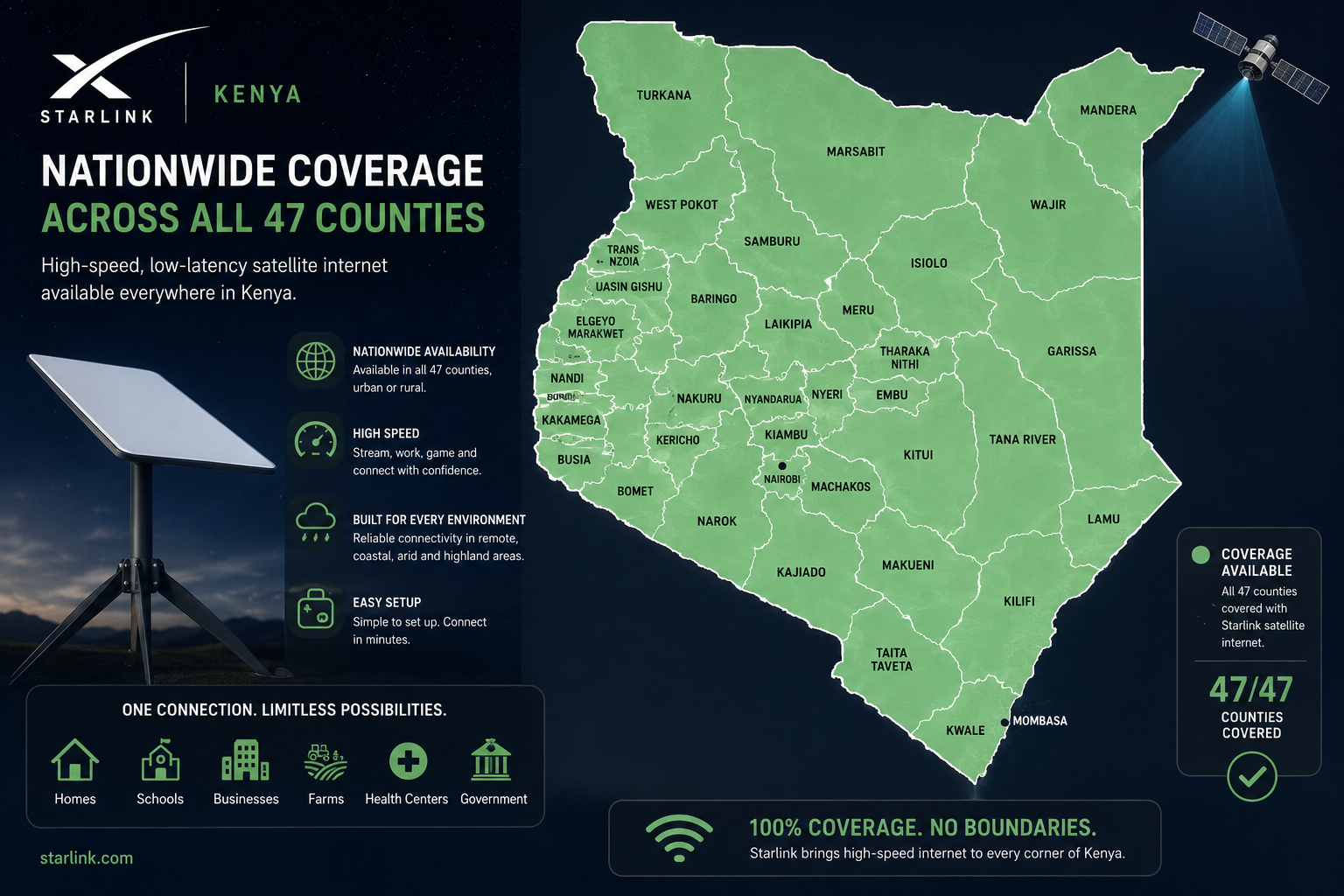
From rapid rise to subscription freeze — how network saturation, aggressive local competition, and tightening regulation combined to reverse Starlink's early momentum in Kenya's fixed broadband market.
Introduction: A Promising Start Interrupted
When SpaceX's Starlink launched in Kenya in July 2023, it arrived with considerable fanfare. Here was a satellite internet service that promised to bridge the country's persistent digital divide — beaming high-speed, low-latency connectivity to remote villages, off-grid farms, game lodges in the Mara, and anyone who had spent years suffering on slow or unreliable terrestrial connections. By mid-2024, that promise seemed real: the subscriber base had swelled from a few thousand to over 19,000, and Starlink had climbed to seventh place among Kenya's internet service providers (ISPs) with a market share of 1.1%.
Then came the reversal. In November 2024, Starlink abruptly paused new residential sign-ups in Nairobi, Kiambu, Machakos, Kajiado, and Murang'a — the country's most densely populated counties. Would-be subscribers who visited the sign-up page were greeted with a blunt 'sold out' message. Existing customers began experiencing deteriorating speeds. And when Kenya's Communications Authority (CA) released its Q1 2025 sector statistics, the numbers told a stark story: Starlink had lost 2,080 subscribers in just three months, its market share had slipped from 1.1% to 0.9%, and it had dropped to eighth place — overtaken by Dimension Data Solutions. The Starlink Kenya market share drop had become official data.
This article unpacks what happened, why it happened, and what the road ahead looks like for satellite internet in Kenya.
Starlink Kenya Market Share: Key Statistics at a Glance
|
Metric |
Dec 2024 |
Mar 2025 |
Jun 2025 |
|
Subscribers |
19,146 |
17,066 |
17,425 |
|
Market Share |
1.1% |
0.9% |
0.8% |
|
ISP Rank in Kenya |
7th |
8th |
9th |
|
Avg Download Speed |
~100 Mbps |
47 Mbps |
~53 Mbps* |
|
Sign-up Status (Nairobi) |
Active |
Frozen |
Resumed (Jun 2025) |
* Latency improved after local ground station launch in early 2025. Speed data sourced from CA reports and Ookla Speedtest Intelligence.
1. The Subscription Freeze: Starlink's Self-Imposed Setback
The single most damaging event in Starlink's Kenyan trajectory was its own decision to halt new subscriptions. In November 2024, facing network saturation in its busiest coverage zones, Starlink suspended new residential activations across several of Nairobi's surrounding counties. The pause lasted seven months — a commercially costly eternity in a market moving as fast as Kenya's internet sector.
Why Did Starlink Freeze Sign-ups?
The answer lies in the fundamental architecture of Low Earth Orbit (LEO) satellite internet. Each Starlink antenna beam serves between 1,000 and 1,500 users within a 22-kilometre radius. In sparsely populated rural areas, that capacity is more than adequate. But in dense urban centres like Nairobi, where subscriber growth outpaced SpaceX's assumptions, congestion became inevitable.
Compounding the problem was the absence of local ground infrastructure. Until early 2025, virtually all Kenyan Starlink traffic was routed through European gateways — primarily Frankfurt — a setup that added significant latency and introduced a structural bottleneck for a rapidly growing user base. Median download speeds, which had hovered around 100–200 Mbps at launch, had collapsed to 47 Mbps by May 2025, according to Ookla Speedtest data. Kenya became the second-slowest Starlink market in Africa, ahead of only Madagascar.
When prospective subscribers visited the sign-up page, they encountered a 'sold out' notice — a jarring message for a service marketed on the promise of universal connectivity. Kenya was not alone in experiencing this: Starlink simultaneously halted orders in Nigeria, Ghana, Zambia, and Zimbabwe, disrupting service for over 100,000 users across the continent.
2. The Numbers: How Starlink Lost Ground While the Market Grew
The Starlink Kenya market share drop did not occur in isolation — it happened against a backdrop of a booming fixed internet sector. Kenya's total fixed internet subscriber base grew 8.1% in Q1 2025 alone, adding over 150,000 new connections across all providers. Starlink was the only major ISP to record a net subscriber decline during this period.
Q1 2025: Who Won What Starlink Lost
While Starlink shed 2,080 subscribers, its competitors moved aggressively to capture the gap. Safaricom, already Kenya's dominant broadband provider, added nearly 57,000 subscribers in the same quarter. Poa Internet Kenya gained 23,461 users, and Vilcom Network added a further 16,702. These figures underscore a painful truth for Starlink: its subscription freeze did not just pause its growth — it actively handed market share to rivals who were already outpacing it on price.
By Q4 2025, Starlink's market share had slipped further to 0.8%, despite adding 359 new subscribers after resuming sign-ups in June 2025. The problem was structural: Starlink was growing too slowly in a market expanding too rapidly. By June 2025, the company had dropped to ninth place among Kenyan ISPs — a ranking that reflects the competitive intensity of a market where fibre operators, 4G providers, and agile local players are all fighting for the same urban consumer.
3. The Competition: Local ISPs Closed the Gap on Every Front
For much of its early tenure in Kenya, Starlink's proposition was simple: where terrestrial internet failed, satellite prevailed. Slow fibre rollout in rural areas, unreliable 4G in peri-urban zones, and frequent outages in established networks made Starlink's premium pricing easier to justify. By late 2024, that advantage had eroded — and competitors had become significantly more formidable.
Safaricom: 5G, Aggressive Pricing, and a 36% Market Grip
Safaricom commands 36.5% of Kenya's fixed internet market — a dominance it defended fiercely as Starlink gained traction. When Starlink introduced rental plans and slashed hardware prices in mid-2024, Safaricom responded with its own aggressive countermeasures: 5G routers priced at just Ksh 3,000 (compared to Starlink's Ksh 28,000–45,000 dish kit), and broadband packages topping out at 1,000 Mbps. The contrast was stark. A Safaricom subscriber could access gigabit-class speeds for a fraction of the upfront cost, with local customer support available in Swahili and other Kenyan languages.
In August 2024, Safaricom also formally lobbied the Communications Authority to require satellite ISPs to partner with local mobile network operators — a move widely read as a regulatory offensive against Starlink's independent model. The company argued the requirement was necessary for security, infrastructure investment, and job creation.
Poa Internet, Vilcom, and the Rise of Community ISPs
The competitive threat to Starlink was not limited to Safaricom. Poa Internet Kenya — which built its model around affordable, community-level Wi-Fi in low-income urban areas — gained over 23,000 subscribers in Q1 2025. Vilcom Network added 16,700. Both providers offered free installations and rapid local support, creating a service experience that Starlink's remote-assistance model struggled to match.
Jamii Telecommunications and Wananchi Group's Zuku also expanded customer outreach, offering multilingual support and proactive hardware troubleshooting — a direct contrast to Starlink's predominantly digital, self-service approach.
4. The Cost Problem: Premium Pricing in a Price-Sensitive Market
Kenya's internet market is one of the most price-competitive in Africa. Monthly data costs have trended downward for years, driven by fibre expansion, mobile data competition between Safaricom and Airtel, and the entry of community providers like Poa Internet.
Against this backdrop, Starlink's pricing has always been a friction point. The hardware kit — a dish and router — originally retailed at Ksh 89,000 before Starlink introduced a rental scheme and a cheaper Mini Kit, bringing the entry cost down to approximately Ksh 28,000–45,000. Monthly subscriptions run from approximately Ksh 3,200 (around $25) for the basic residential plan to higher tiers for priority data.
By comparison, Safaricom's 5G router required only Ksh 3,000 upfront. Poa Internet offered unlimited home Wi-Fi plans for as little as Ksh 1,575 per month. Even in areas where Starlink's satellite coverage was technically superior, the economics were difficult to defend for cost-conscious Kenyan households.
Kenya Fixed Internet: ISP Comparison (2025)
|
Provider |
Market Share |
Q1 2025 Subscribers Added |
Max Speed |
Upfront Cost |
|
Safaricom |
36.5% |
+56,969 |
1,000 Mbps |
Ksh 3,000 |
|
Poa Internet |
~4% |
+23,461 |
~50 Mbps |
Free install |
|
Vilcom Network |
5.4% |
+16,702 |
~100 Mbps |
Varies |
|
Starlink |
0.8–0.9% |
-2,080 (Q1 2025) |
~47–200 Mbps |
Ksh 28K–45K |
Sources: Communications Authority of Kenya Q1–Q4 2025 Sector Statistics; Ookla Speedtest Intelligence; TechTrendsKE.
5. Regulatory Headwinds: The Rules Are Getting Stricter
Beyond the market dynamics, Starlink faces a tightening regulatory environment that could structurally increase its cost base and limit its operational flexibility in Kenya.
Satellite Licence Fee Hike
Kenya's Communications Authority has proposed increasing satellite ISP licensing fees nearly tenfold — from approximately Ksh 1.2 million to Ksh 15 million — and introducing an annual levy equivalent to 0.4% of turnover. The proposed figures were later revised upward further in 2026, with some analyses placing total potential compliance costs as high as Ksh 45 million for satellite operators over the licence period. These costs, if passed into effect, would likely be absorbed partly by operators and partly passed on to subscribers through higher monthly rates.
Subscriber Registration Requirements
In February 2026, new regulations under the Kenya Information and Communications (Registration of Telecommunications Service Subscribers) Regulations 2025 mandated that all Starlink users complete in-person identity verification — a requirement that added friction to both new sign-ups and retention of existing subscribers unfamiliar with the process.
The Safaricom Partnership Pivot
The competitive hostility that once defined the Safaricom-Starlink dynamic has since shifted. In November 2025, Safaricom — through its parent company Vodacom — signed a partnership agreement with Starlink to resell Starlink equipment and integrate satellite technology into its rural coverage strategy. Safaricom CEO Peter Ndegwa framed the shift simply: satellite should complement terrestrial networks, not compete with them. The partnership could eventually expand Starlink's reach into underserved rural areas under Safaricom's distribution umbrella — though the regulatory machinery Safaricom helped set in motion shows no sign of reversing.
6. The Infrastructure Fix: Ground Station and Latency Improvement
One of Starlink's most significant structural improvements in Kenya came in early 2025 with the commissioning of its first local ground station (gateway) in Nairobi. Prior to this, all Kenyan Starlink traffic was routed through European gateways — a setup that inflated latency to around 120 milliseconds and created performance inconsistencies for time-sensitive applications like video conferencing, online gaming, and VoIP.
With the Nairobi gateway operational, average latency dropped to approximately 53 milliseconds — a meaningful improvement, though still higher than the sub-20 ms achievable on fibre. Download speeds also stabilised somewhat, though peak-hour congestion in urban areas remained a persistent complaint. The ground station also cleared a long-standing regulatory obstacle that had required traffic to be processed offshore.
Starlink resumed new sign-ups in Nairobi and surrounding counties — including Kiambu, Machakos, Kajiado, and Murang'a — in June 2025 after the seven-month freeze. The resumption was welcomed by consumers but arrived too late to prevent the market share erosion that had already occurred.
7. Where Starlink Still Wins: The Rural Connectivity Case
Despite the urban setbacks, Starlink's core value proposition remains intact in the specific context for which satellite internet is genuinely superior: remote, rural, and off-grid connectivity. In Turkana, Garissa, Marsabit, and across Kenya's vast agricultural hinterland, fibre optic cable does not reach and mobile data signals are weak or non-existent. In these areas, Starlink is not competing with Safaricom or Poa Internet — it is the only viable broadband option.
Schools in underserved counties have used Starlink to access digital learning resources for the first time. Safari lodges in the Maasai Mara have replaced expensive VSAT connections with Starlink dishes. Agri-tech platforms have extended remote monitoring and advisory services to smallholder farmers. These use cases represent a durable, defensible market segment where neither Starlink's price premium nor its urban congestion problems apply.
The risk for Starlink is that the narrative of market share decline in urban Kenya could obscure this rural impact — and that regulators focused on urban market competition may inadvertently raise costs that ultimately price Starlink out of the rural communities that need it most.
8. What the Starlink Kenya Market Share Drop Means for Investors and Consumers
For Consumers
• Urban users with access to fibre or 4G/5G have better value alternatives to Starlink in 2025–2026.
• Rural users without terrestrial broadband options remain Starlink's most underserved and most loyal customers.
• Hardware costs (Ksh 28,000–45,000) remain the single biggest barrier to broader adoption, despite the rental scheme.
• If regulatory fee hikes are passed on, monthly subscription costs could increase by 10–15%.
• The Safaricom-Starlink partnership may eventually create bundled offerings that improve affordability.
For Investors and the Broader Market
• The Kenyan episode illustrates the structural tension between LEO satellite internet's urban capacity limits and the marketing promise of universal coverage.
• Competitors moving quickly — the gap between Starlink's 0.8% market share and Safaricom's 36.5% reflects how quickly terrestrial ISPs can respond when regulatory and market conditions favour them.
• SpaceX's ongoing constellation expansion (including higher-capacity V2 satellites) may eventually resolve the urban congestion problem, but the timeline is uncertain.
• Amazon's Project Kuiper, expected to enter commercial service in Africa in 2025–2026, will introduce a well-capitalised competitor that could further pressure pricing.
Frequently Asked Questions (FAQ)
Why did Starlink lose market share in Kenya?
Starlink's market share dropped primarily because it paused new subscriptions in key Kenyan counties from November 2024 to June 2025 due to network saturation. During this period, local competitors added hundreds of thousands of subscribers while Starlink's user base shrank. Speed degradation and high hardware costs also contributed.
What is Starlink's current market share in Kenya?
As of the Communications Authority's Q4 2025 report, Starlink holds approximately 0.8–0.9% of Kenya's fixed internet market, placing it ninth among ISPs. Its subscriber count stood at around 17,425 as of mid-2025.
Has Starlink resumed sign-ups in Nairobi?
Yes. Starlink resumed new residential sign-ups in Nairobi, Kiambu, Machakos, Kajiado, and Murang'a in June 2025, following a seven-month freeze. The resumption came after Starlink commissioned a local ground station in Nairobi that improved network capacity and reduced latency.
Is Starlink good in rural Kenya?
For rural areas without fibre or reliable mobile broadband, Starlink remains the most viable high-speed internet option. Its satellite-based coverage extends to regions where Safaricom, Poa Internet, and other terrestrial providers have no infrastructure.
How does Starlink compare to Safaricom in Kenya?
Safaricom dominates Kenya's fixed internet market with a 36.5% share and over 678,000 subscribers. It offers speeds up to 1,000 Mbps and 5G routers from Ksh 3,000. Starlink offers satellite connectivity (particularly valuable in rural areas) but carries a higher upfront cost of Ksh 28,000–45,000 for hardware and had median download speeds of 47 Mbps in urban areas by early 2025.
Will Starlink prices increase in Kenya?
Potentially. The Communications Authority's proposed satellite licence fee increases — including a 0.4% revenue levy and a one-time fee of up to Ksh 15 million — could raise operating costs for Starlink, some of which may be passed on to subscribers. No confirmed price increases had been announced as of mid-2026.
Conclusion: A Setback, Not a Surrender
The Starlink Kenya market share drop is a cautionary story about scaling too quickly in dense urban environments without adequate local infrastructure — and about the speed at which well-funded terrestrial competitors can respond when an opportunity opens. The subscription freeze, degraded speeds, regulatory pressure, and price competition from Safaricom all converged to reverse gains that had taken over a year to build.
But the story is not over. Starlink's ground station investment has improved the technical fundamentals. The Safaricom partnership opens a new distribution channel. And in rural Kenya, the case for satellite internet is stronger than ever. The coming 12–24 months will determine whether Starlink can rebuild urban credibility while defending and expanding its rural stronghold — and whether Amazon's Project Kuiper arrives as a disruptive competitor or a market expander.
For Kenyan consumers watching the satellite internet sector evolve, the practical takeaway is straightforward: if you are in a well-served urban area with fibre or 5G access, Starlink is expensive for what it offers today. If you are beyond the reach of Kenya's terrestrial networks, it remains the most reliable broadband option available.
Sources: Communications Authority of Kenya Sector Statistics Reports (Q1–Q4 2025); Ookla Speedtest Intelligence; TechTrendsKE; Kenyan Wall Street; Tech-ish Kenya; Space in Africa; TechPoint Africa; AInvest; Ecofin Agency; Kenya Insights.
Last updated: June 2026